Peaked at #10 Off the board
LlamaIndex Launches DPP
LlamaIndex introduces the Document Parsing Protocol (DPP) to standardize how parsers handle tables, forms, charts and diagrams.
Original post
Introducing the Document Parsing Protocol (DPP)
There are hundreds of different OCR models and tools, but they might all parse a document in different ways.
Some errors are very clear-cut (e.g. hallucinating text, or completely misaligning a table), but many errors are much more ambiguous (e.g. how to represent split tables sharing a header). It's an issue that plagues most parse benchmarks too, because they inherently reward a certain style even if other styles might be semantically correct.
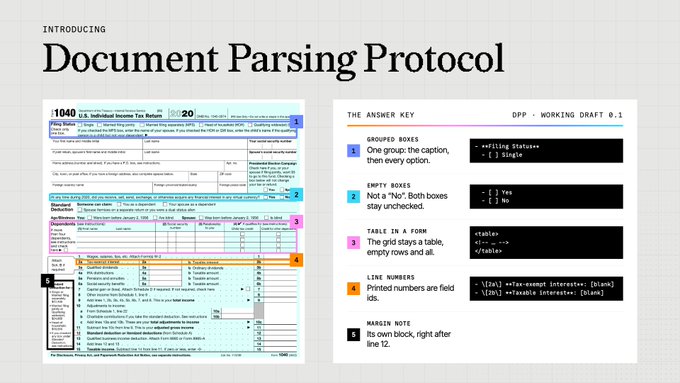
We introduce a protocol that proposes a standard way of parsing these documents into a correct format. We've curated a list of 140 rules that cover literally every aspect of doc parsing, for instance:
- tables: borderless whitespace tables, header-only tables, horizontal slicing, side-by-side mini tables
- forms: key-value regions, checkboxes, checklists, ids and labels, fields outside the form,
- charts: standardized chart output, multiple charts, gantt charts, line charts
You can use DPP as an evaluation rubric for LLMs when determining the quality of parsing a document.
It's not a full evaluation benchmark (yet), but an initial evaluation guide, and meant to encourage a discussion on what are the "best" ways to parse a document.
Check it out: https://t.co/HsLh6ma9bB
Blog: https://t.co/0md2O2M2MfQuoting @llama_index: Is that a table, or just text that happens to line up?
If a table has two header rows, should the output preserve both?
Parsers make these judgment calls differently. Those differences shape what your agent understands about a document.
We built the Document Parsing Protocol (DPP) to give those decisions a shared rulebook.
DPP covers text, tables, forms, charts, and diagrams, and even includes
Discussion 0
Sign up Sign in to join the discussion
No comments yet. Start the conversation.