Peaked at #1 Off the board
Saylor discusses Strategy's Bitcoin and digital credit
Author analyzes Saylor and Phong Le interview, saying digital credit is Strategy's core model.
Key points
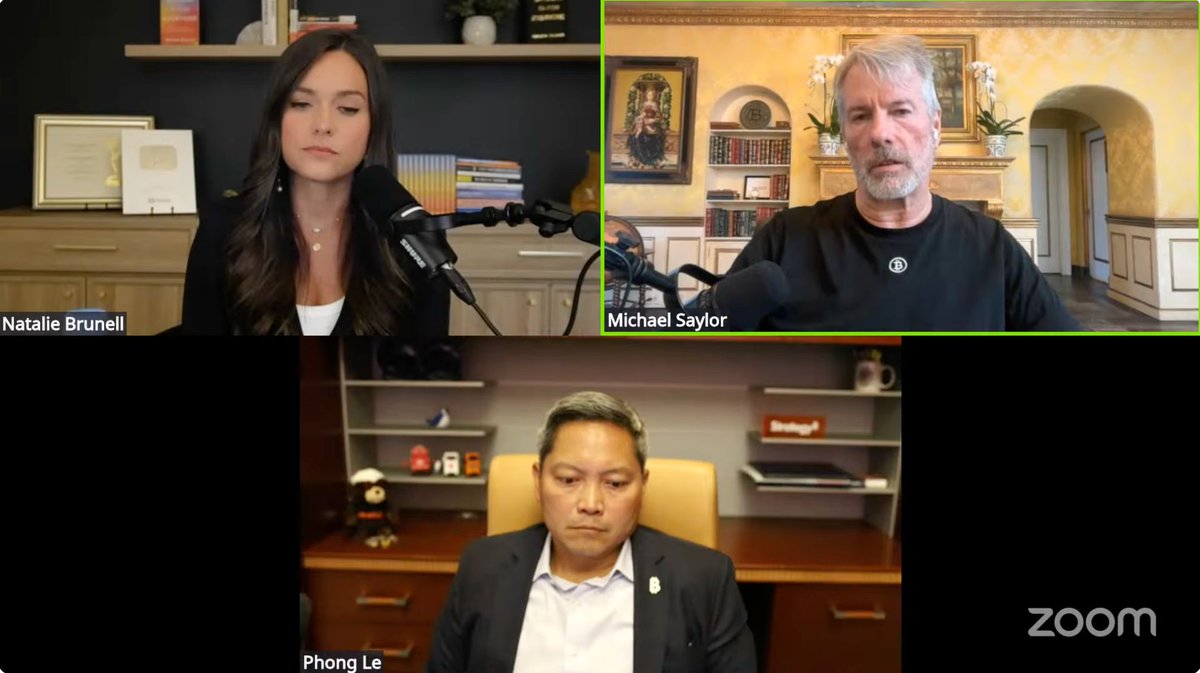
- Saylor, @PhongLe and @NatBrunell took questions in Strategy's Q3 2026 Investor Q&A on Bitcoin Per Share, funding dividends through a downturn, and long-term value for $MSTR shareholders.
- The Q&A covers when Strategy issues equity, buys Bitcoin and repurchases $STRC, along with $STRC repurchases and the $100 target price.
Key points and the reaction summary are written by AI from the posts on this page. Check the original post. How we use AI
Original post
If you're an $MSTR investor, grab a coffee and get comfortable.
Natalie Brunell's Q&A with Michael Saylor and Phong Le yesterday was one of the most revealing discussions I have seen.
And actually it couldn't have come at a better time considering the recent market dynamics.
My full thoughts below on what stood out to me.
1. Digital Credit Is The Business Model
Saylor made it explicitly clear that creating Digital Credit is central to Strategy's business model.
"The number one way that the company creates shareholder value is to issue good credit."
By issuing Digital Credit and investing the proceeds in $BTC, Strategy can capture the spread between its Cost Of Credit and Bitcoin's appreciation.
The more efficiently Strategy can issue Digital Credit, the greater the economic spread it can capture.
And the more successfully it can scale that model, the more value it will create for common shareholders.
2. $STRC Buybacks Are About Building Trust
Saylor emphasised that supporting Digital Credit during difficult market conditions is essential to building long-term customer confidence.
"People judge you based upon how you treat them in difficult markets."
This reinforces something I have been arguing for months.
Supporting $STRC through buybacks demonstrates Strategy's commitment to its customers.
Management explicitly discussed the downstream implications of this approach, including stronger investor confidence.
In turn, that confidence will attract more durable investors, improve liquidity and ultimately increase Strategy's capacity to issue Digital Credit.
Saylor also acknowledged that decisions which appear less profitable in the short term can become considerably more valuable in the long-term.
For reasons I have explained many times elsewhere, I believe management is making the right decision by prioritising the long-term success of the product over short-term financial optimisation.
3. Product Quality Over Short-Term Growth
Saylor acknowledged that higher dividend rates could stimulate additional demand for $STRC, but explicitly rejected pursuing growth at the expense of common shareholders.
"There might very well be more demand for this if we were paying 15% or 20% than 12%...We just don't wish to do that."
His reasoning was straightforward.
Raising the dividend would increase Strategy's Cost Of Credit and reduce the economic spread available to $MSTR shareholders.
As Saylor put it:
"We're playing the long game."
Instead, Strategy is prioritising price stability, liquidity and investor confidence.
Again, I strongly agree with this approach.
Higher dividend rates may attract incremental demand, but they won't necessarily attract the type of durable institutional investors Strategy is targeting.
And increasing the Cost Of Credit ultimately comes at the expense of common shareholders.
4. $STRC Supply Will Adjust To Demand
Saylor explained that Strategy intends to continuously adjust outstanding $STRC supply according to organic demand rather than pursue issuance growth at any cost.
He estimates that the current level of organic demand for $STRC at a 12% dividend is approximately $5B–$7.5B.
I have no real view on how accurate those numbers are likely to turn out to be. If anything, I would lean lower.
To date, Strategy has repurchased ~$3B of $STRC below par.
Per Saylor, the objective is to establish an equilibrium where buyers and sellers balance around par.
This is something I have consistently advocated.
Maximise the proportion of holders who genuinely want the product for what it is at the minimum sustainable dividend rate.
That establishes a stable foundation upon which future growth can compound.
5. Capital Allocation Is Dynamic
Saylor explained that Strategy evaluates capital allocation opportunities across Bitcoin, common equity, Digital Credit and cash on an ongoing basis.
"We can buy or sell dollars, buy or sell Bitcoin, buy or sell MSTR common stock, buy or sell STRC."
Crucially, management evaluates these transactions against different accretion thresholds rather than relying on a single mNAV multiple.
For example, retiring $STRC through $MSTR issuance can increase net Bitcoin Per Share even when $MSTR trades below 1x mNAV.
Saylor also explained that retiring Digital Credit liabilities strengthens net reserves, reduces risk and creates additional capacity for future credit issuance.
This aligns with my view that capital allocation decisions should ultimately be judged by their long-term impact.
6. Balance Sheet Resilience Is Improving
Saylor highlighted how significantly Strategy's balance sheet has strengthened during the recent market downturn.
"We've got three years of cash right now, 3.4 years or something."
He also explained that Strategy continuously adjusts its capital structure in response to changing market conditions rather than relying on infrequent refinancing transactions.
I love this because it means the company can reduce risk by retiring Digital Credit liabilities when credit markets contract.
The combination of ~3.4 years of USD liquidity coverage and greater capital allocation flexibility considerably strengthens Strategy's ability to withstand stressful market conditions.
7. Liquidity Is Becoming A Competitive Advantage
Saylor emphasised that the liquidity of $STRC is becoming an increasingly important part of Strategy's competitive positioning and future issuance capacity.
"STRC traded $600 million yesterday."
He explained that this liquidity, combined with Strategy's shelf registration and capital markets infrastructure, allows the company to issue substantial amounts of Digital Credit rapidly when demand returns.
He also made clear that institutional credibility takes time to establish.
"It took us four years of work to build the credibility and the trust in the market."
I see liquidity, distribution and credibility becoming increasingly important competitive advantages.
And when institutional demand eventually accelerates again, Strategy will be much better positioned to capture that opportunity at scale.
Summary (TL;DR)
This discussion reinforced the fact that Strategy's long-term success will ultimately depend on its ability to build a trusted, scalable Digital Credit business.
And for me, management is making the right decisions to achieve that.
By prioritising product quality, price stability and investor confidence over short-term issuance growth, Strategy is laying the foundations for a considerably larger business over time.
The stronger the product, the greater the confidence.
The greater the confidence, the more durable the demand.
And the more durable the demand, the greater Strategy's capacity to issue Digital Credit, acquire Bitcoin and compound Bitcoin Per Share.
Of course, none of this eliminates the importance of disciplined capital allocation, balance sheet resilience or Bitcoin outperforming Strategy's Cost Of Credit.
But I believe the decisions management is making today will have a disproportionate impact on the company's ability to create shareholder value over the next five to ten years.
The foundations of a successful Digital Credit business are being established today. The real opportunity will be realised as that business scales.
As Saylor put it:
"Strong credit makes a strong treasury company."
I couldn't agree more.
What others are saying
1 more-
Michael Saylor @saylor 2,083
Saylor posts Strategy's Q3 investor Q&A covering when to buy Bitcoin versus STRC, Bitcoin per share and dividend funding.
View on X
Top replies on X
Sign in to see 5 top replies from X
From @saylor, @BGL1969, @ToddwithHonor and others. Spam removed, with English and Chinese translations.
Discussion 0
Sign up Sign in to join the discussion
No comments yet. Start the conversation.